Tuesday, August 31, 2010

How to Migrate Your Entire Google Account to a New One

 
Image representing Google as depicted in Crunc...

Image via CrunchBase

Whether you finally decided to shed sassyhacker957@gmail.com for a more professional handle or you want to swap Google accounts for less embarrassing reasons, Google doesn't have a built-in system for migrating your data to a new account. So we figured it out.

A lot of us have a ton of data stored in Google's services, but if you want to migrate to

How to Migrate Your Entire Google Account to a New Onea new Google account, you'll need to do some digging. Here's how to migrate your data from Google's most popular services (Gmail, Google Calendar, Docs, Reader, Voice, Blogger, and YouTube) from your current account (hereafter referred to as "Account 1") to your new account (hereafter, "Account 2") while incurring the least amount of data loss.

A few of the services (such as Google Reader) adhere to some fairly universal import/export standards that make it easy, whereas other services (such as newer YouTube accounts) may require you to start from scratch to keep full functionality. In these few cases, we'll note what you can do and what you'll lose by using that method instead of starting over.

Note: Unfortunately, Google Apps has still not caught up to regular Google Accounts in terms of available services. While some of these (such as Calendar and Documents) will work for migrating to a Google Apps account, other services (such as Reader or Voice) are still not available to Google Apps at this time. I'll note where the service is not available to Apps users, as well as when they need to go through a different process of migrating that particular service.

Migrating Gmail

Migrating all your email from one Gmail account to another is a fairly involved process—and one which we detailed in our guide to changing your Gmail account without losing your email. So hit up that original guide for your Gmail migration, then come back for the rest.

Migrating Google Calendar

There are two ways to migrate your Google Calendar. One of them takes a bit longer, but we'll only use that method for your main calendar (the one that, by default, is named after your Gmail address). All of the sub-calendars, or "delegates", of the account are easier to migrate, so we'll do that second.

To migrate your main calendar, go into your Google Calendar settings and click on the Calendars tab. You'll see an option to export all your calendars, at once, to your hard drive in iCalendar format. Export them to your drive and unzip them if necessary.

Next, go to your new account (it's easiest to have each account logged into Google in a separate browser), go to Settings > Calendar Settings > Calendars and create a new one. Name it whatever you like, click Create Calendar, and then hit the import button at the bottom of the page. Choose the .ical file corresponding to your main calendar and upload it, choosing the empty Google Calendar you just created as its destination. You'll see that it shows up in calendar view.

If you have more calendars you want to import beyond the default, we're just going to share them with the other account. Go back to the Calendars tab of Account 1's settings and hit the "Share This Calendar" button next to a calendar. Type in the Account 2's address and hit Enter. Change the permissions in the drop-down window to "Make Changes AND Manage Sharing" and hit Save. Account 2 will receive an email saying that you've shared a calendar, and provide a confirmation link. The first time you receive an invitation, you'll need to click on this link, but afterward the calendar will just show up automatically. You can then go back to the Calendars tab of your new account's settings, hit the "Shared: Edit Settings" link and remove Account 1 at the bottom, by clicking the trash can icon. (This removes Account 1 from sharing the calendar, so Account 2 is left with full ownership of the calendar.) Repeat this for each of your calendars and you'll have migrated everything you need. This method works for both regular Google accounts as well as Google Apps.

Migrating Google Docs

If you're migrating to a regular Google account, transferring your Google Docs is easy. Just select all the documents you want to migrate, go to the More Actions drop down menu, and choose Change Owner. Type in Account 2's address in the box that comes up. You'll see all your documents in Account 2.

Unfortunately, Google Docs does not allow you to change the owner to someone of a different domain, meaning migrating your documents to a Google Apps account takes a bit longer. Luckily, it's still pretty easy. Select all the documents you want to transfer, go to the More Actions drop down, and click on Export. This will compress all the documents into a zip file and download it to your hard drive. Afterward, you can go to Account 2 and hit the Upload button in the top left corner, and choose all the documents you just downloaded. It'll take a bit longer, but you still won't lose any functionality or data, which is nice.

Note that any documents for which you are a collaborator but not the owner will not transfer correctly with either of these methods; you'll need to contact the owner of those documents and tell them to re-share them with your new account.

Migrating Google Reader

Migrating your RSS feeds is probably the easiest part of this process, but it unfortunately only works with regular Google accounts (since Apps accounts do not have access to Reader). Just go into Google Reader's settings and click on the Import/Export tab. At the bottom, you'll see a link that says "Export Your Subscriptions as an OPML File" which will download a single file to your computer containing all of your feeds. Click on this link, and then go to the same Import/Export tab in Account 2's Settings. This time, click the Choose File button and navigate to the file you just downloaded. After uploading this file, all your feeds should show up in Reader. Note that this won't sync your read and unread counts, nor will it sync your starred or shared articles, so you'll have to re-star anything you still want to reference (and re-friend anyone you follow on Reader).

Migrating Blogger

Migrating your Blogger account will be similar to Calendar and Docs, but with a few caveats. Sign into your current Blogger account, go to Settings, and hit the Permissions tab. Click the Add Authors button and type in Account 2's address. You'll get an email notification in that account's inbox, so head over to your other browser and accept the invitation to become an author of that blog. Once you have, you can give that account administrative rights with Account 1 by going to Settings > Permissions and clicking on "grant admin privileges". Once you've done so, you can remove Account 1 from the blog by clicking the remove link next to its address.

Note that when you do this, Account 1's posts will stay up as they were before. However, if you delete your original Google account, all the pictures will turn into broken images. You could re-upload and re-post all the pictures, but honestly, there's no reason to delete the account outright, even if you never plan on using the Gmail address again. In fact, I've found that having an old Google Account makes a handy address to direct all your spam.

Migrating YouTube

Unfortunately, you can only migrate your YouTube account if you created it before May 2009. If you are one of these lucky folks, though, it's quite easy. Just go to your Account settings and hit Manage Account. At the bottom of the list you'll see an option to unlink your YouTube and Google accounts. Click the link and follow the steps. The next time you log into YouTube, it will prompt you to link it to another Google Account. If you created your YouTube account after May 2009, though, you will not have this option. Your only choice is to re-upload all of your videos to a new YouTube account.

Migrating Google Voice

How to Migrate Your Entire Google Account to a New One

When GrandCentral became Google Voice, Google provided a path for users to switch accounts since many people associated their GrandCentral account with the wrong Google Account. Later on, they expanded this to all Google Voice users, at least until they provide a sanctioned method to migrate your data. Thus, just fill out this form and your account should eventually transfer over. Note that at the moment, this does not work for Google Apps accounts.

obama_apple_pacman

Wednesday, August 11, 2010

A new look for AdSense for content ad units

The new AdSense interface offers features such as more detailed reports with graphs and the ability to complete common actions in bulk. Fill out our interest form, and we may be able to include you in the beta test of the new interface.

A new look for AdSense for content ad units

Monday, August 09, 2010 | 11:10:00 AM
Labels: 
We're excited to announce a revamped design of three of our AdSense for content ad units! After analyzing publisher site layouts and reviewing requests around the world, we decided to make our formats more space-efficient and visually pleasing by changing the layout of the text. We spent a lot of time experimenting with different possibilities, and we're starting with changes to the following ad units:
  • Leaderboard (728x90): the title, description, and URL are now arranged in rows instead of columns (except in the case when only one ad is showing)
  • Medium and large rectangles (300x250, 336x280): the URL is now in the same line as the title
In certain cases, you'll also see a few minor adjustments to the font size. For example, the font size for the leaderboard with four ads is much more readable. Please note that these changes will roll out over the next few weeks.


During testing, the redesigned ads performed extremely well. We'll continue to experiment and innovate on our formats to help you monetize your content, and we encourage you to submit ideas in the comments below.


Inside AdSense - Meet Katrina

Monday, August 02, 2010 | 11:20:00 AM
Labels: 
You may have noticed a few posts from me recently, so I wanted to introduce myself to all of you, our fantastic publishers and Inside AdSense blog readers. I've spent the last few years in AdWords (for those of you who are also advertisers, you may remember my name from posts to the Inside AdWords blog) and am very excited to join the AdSense team!

I’m really looking forward to meeting some of you in person at our AdSense in Your City events and engaging with you through our other social media channels. If you don’t already, follow us on Twitter, like us on Facebook, and leave us some comments so we know what you'd like to hear more about. We want to make sure that you’re getting the information you need, and will do our best to provide you with whatever content you find most interesting and useful. To start things off, we're giving the blog a little makeover so it's easier to read and navigate. You should notice the new background soon, and we'd love to hear what you think!

For any technical or account questions, check out the Help Forum, where you can interact with AdSense employees, Top Contributors (expert AdSense users vetted by the AdSense team), and a vibrant community of online publishers ready and willing to answer your toughest questions.

No matter which channel you choose, we look forward to interacting with you. See you in cyberspace!

Switch to the new version of AdSense for search

Wednesday, July 28, 2010 | 11:50:00 AM
Labels: 
Over the last two years, the AdSense team has offered the powerful Google Custom Search Engine (CSE) product as an improvement over the original AdSense for search. After some recent improvements, we're now ready to retire the older version of AdSense for search. If the Google logo on your search results page reads "Powered by Google" instead of the newer "Google Custom Search" then you haven't yet upgraded to the newer version. The new AdSense for search with CSE is available in your account, and we encourage you to make the switch by updating your code as soon as possible.

AdSense for search with CSE gives you more control over your search results without changing how you earn money showing AdSense for search ads. For example, with the new version, you'll have access to advanced features like refinements and promotions. Our team has developed a number of updates and improvements during the past few months, and you can access more advanced features at www.google.com/cse.

Your existing AdSense for search box will continue to work normally for a few more months, and we'll be sure to update you when we retire this version. To take advantage of the benefits offered by the new version of AdSense for search and ensure you don't miss any revenue during the transition, we encourage you to update your code now. You'll just need to regenerate your AdSense for search code by signing in to your account and following these instructions:
  1. Visit your "AdSense Setup" tab and select "AdSense for Search."
  2. Select the sites you'd like your users to be able to search across (Learn More).
  3. Customize the look and feel of your search engine results.
  4. Update the code on your website.
For more information about AdSense for search with CSE, please visit our Help Center.

AdSense: Behind the Scenes - Meet Evanne

Monday, July 26, 2010 | 9:20:00 AM
Labels: , 
In the last video of this series, Evanne, a member of the Partner Development team, talks about her favorite Google perk, her obsession with music, and an important tip she’d like to share with all of you.

We hope you’ve enjoyed learning more about what goes on behind the scenes in AdSense. If you have feedback on this series, or ideas for future series, we’d love to hear them so please leave us a comment!


Access All Your Google Accounts the Same Time With Multiple Sign-in

Inline Expand - Additional Input - Google DocsImage by Janne L via Flickr

Google services permeate most of our online lives, and many of us end up using multiple Google accounts for different projects.  You may have a personal Gmail account, a specialized one for your website, and another for using on public forums and comments.  Before, the only way to access all the accounts would be to use multiple browsers or to usespecial extensions to sign in to multiple accounts at the same time.  Now Google has made it easy to link all of your Google accounts so you can access them directly in the same browser. 
Add Multiple Sign-in to Your Google AccountWould you like to easily access all of your Google accounts without using multiple browsers or special addons?  Here’s how you can use the new Google Multiple Sign-in feature to quickly access all your accounts.
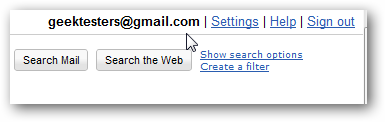
When you access any Google service, such as Docs or Gmail, you’ll see your Gmail address in the top right corner.  To add multiple accounts, we’ll need to edit our Google account.
image
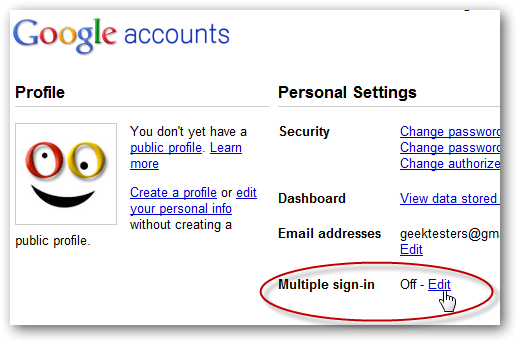
Head over to Google.com/accounts (link below), and sign in with your main, standard Google account.  Make sure you use your primary account, as this will stay the main one you’ll see when you access Google services.
sshot-2010-08-09-[33]
Click Edit beside Multiple sign-in under the Personal Settings section.
SNAGHTML715369
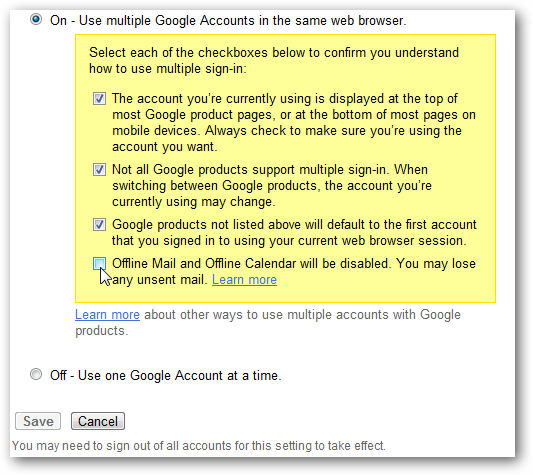
Select the On – Use Multiple Google Accounts in the same browser, and check each box to show you understand the limitations and features of Multiple Sign-in.  Not all of the Google apps currently support it, but most of the main ones such as Gmail and Docs work great with it.  Click Save at the bottom when you’re done.
image
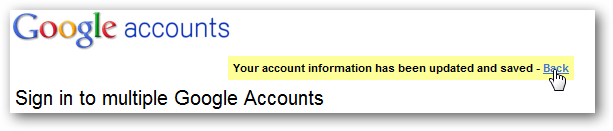
You’ll now see a confirmation in the top of the page.  Click the Back link to go back to your Accounts settings page.
image
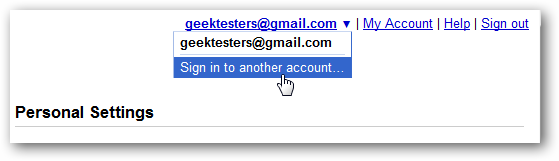
You should now see a down arrow beside your Google account.  Click it, and then click Sign in to another account to add another account.
image
Sign in with the other Google account you wish to add in the login box.
image
Now you’ll see your second Google account when you click the down arrow beside your email address.  Your first, main account will be listed in bold as Default.  Click the other email address to switch to that account.
SNAGHTML7639bf
If you’d like to add another Google account, simply click the Sign in to another account link again to add it.
Remove a Linked Account
Would you like to remove the extra accounts you added?  Unfortunately there isn’t currently a way to remove just one linked account, so you’ll need to turn off Multiple sign-in to remove the accounts.  To do that, login to your Google Accounts page as before, and click Editbeside Multiple sign-in.
image
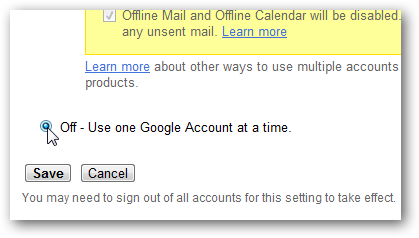
Click the Off bullet near the bottom, and click Save.
image
Once you’ve saved the changes, you’ll only have access to your main Google account.  If you ever decide you’d like to add the second account again, repeat the steps above.  Note that this fully removes the data about your second account from the first account, which is great if you accidently added your account to the wrong Google login.
Conclusion
Whether you have multiple personal Gmail accounts or use one for business and one for personal use, this is a great way to keep your accounts together.  Unfortunately you cannot access your Google Apps accounts this way, though you can already be logged in to a Google Apps account and a standard Gmail account at the same time.  Google Apps account support will be added to this eventually, but for now, it’s a great solution for accessing any of your standard Google accounts without logging off and on or using workarounds.
If you’d like to send and receive email from other email accounts, including Hotmail accounts, inside Gmail, here’s an article on How to Add Pop3 Email Accounts to Gmail.


Saturday, August 7, 2010

DR.HECKLER and MR.KOCH: "Die 4 Something Or Live 4 Nothing" Kick Ass (2010) + Star Trek (2009) MentalBREAKZdown REMIX -DRHK

DR.HECKLER and MR.KOCH: "Die 4 Something Or Live 4 Nothing" Kick Ass (2010) + Star Trek (2009) MentalBREAKZdown REMIX -DRHK

Tuesday, July 27, 2010

More and more people are turning towards coding as a profession/hobby. From freelancers to actual developers, everyone seems to have their foundations strong in at least one programming platform. However, more often than not, there seems to be a problem of actually finding good content online that can teach you to code. Experimenting with a language can only get you so far. To master it, you need to have proper guidance from people who actually know what they are talking about. So where can you find expert guidance without shelling out a fortune for it? You could start with checking out the websites below: Dream In Code Just taking a look at their logo ought to tell you that the community at Dream In Code isn’t something to mess around with. You can browse their content for free, or you can sign up to become a permanent member. They have everything. Right from fundamental elements to programming examples, Dream In Code can help you master any language you choose. That’s because Dream In Code is not restricted to only one language. It covers almost everything under the sun and the community of users/experts is just amazing. They also have a video channel and links to developers’ blogs if you want to look deeper. W3Schools If what you want to master is a Web technology, you’ve got to give W3Schools a look. There’s hardly a place on the Internet that’s as exhaustive as W3Schools when it comes to tutorials about Web technologies. You can get tutorials ranging from plain-Jane HTML, right up to AJAX and the likes. There’s even Server Side Scripting thrown into the mix if that’s what you fancy. Eloquent JavaScript If you’ve ever had to use a Greasemonkey Script or a Bookmarklet, you have a clue about the kind of power that JavaScript possesses. It can dynamically modify the contents of the page that you are viewing. If you’ve ever wondered how any of this is done, then you’ve got to checkout Eloquent JavaScript. This is an interactive tutorial, which you can either read off the Internet, or download as an archive and use on your local disk. It includes a live console to try out any code that you might want to. The entire tutorial is written in very lucid English, and is very easy to follow. TryRuby Ruby is another one of those languages that is taking the world by storm. Slowly, but surely, it’s making its presence felt on the Internet. If you are thinking of venturing out into web application development, then you’ve got to give Ruby a shot. There’s a chance you may never have to look back. The only trouble is finding good sources of Ruby tutorials. TryRuby is a website that’s dedicated to teaching you about Ruby. When you first open the page, all you get is an interactive console for you to code in. Type “help” (without the quotes) and hit Return/Enter to start the Ruby tutorial. Like Eloquent JavaScript, TryRuby is not at all intimidating. Five minutes into the tutorial and I was wondering whether the syntax can really be that simple. A Miscellany of HTML5 Tutorials Last but not least, we come to HTML5. HTML5 has been creating a furore all over the Internet over the last year or so. It’s definitely going to be big (especially with giants like Apple and Google backing it). Therefore, as a developer, you’ve got to have knowledge (either elementary or advanced) about the capabilities of this standard. Tripwire Magazine has a list of more than 30 tutorials at their website. You can get access to all of them using the link above. Now that you have our list of resources from where you can learn how to code, why don’t you pick up that keyboard and put your fingers to good effect? Once you master a language and come up with an awesome app, let us know about it and we might just dedicate a post to it. In the meantime, check out some other programming / coding posts that we have done in the past, for further inspiration : Top 10 Professional Sample Code Websites For Programmers – by Ryan Learn To Code At Any Level With Google Code University – by David 4 Great Websites To Make You A Visual Basic Guru – by Ryan 6 Beginner Resources For Learning Mac Programming – by Bakari 6 Free Sites To Learn About Programming in PHP – by Jack Top 5 Sites To Learn CSS Online – by Daniel Image Credit: kakaopor.

More and more people are turning towardscoding as a profession/hobby. From freelancers to actual developers, everyone seems to have their foundations strong in at least one programming platform.
However, more often than not, there seems to be a problem of actually finding good content online that can teach you to code. Experimenting with a language can only get you so far. To master it, you need to have proper guidance from people who actually know what they are talking about.

So where can you find expert guidance without shelling out a fortune for it? You could start with checking out the websites below:

Dream In Code

Just taking a look at their logo ought to tell you that the community at Dream In Code isn’t something to mess around with. You can browse their content for free, or you can sign up to become a permanent member.
They have everything. Right from fundamental elements to programming examples, Dream In Code can help you master any language you choose. That’s because Dream In Code is not restricted to only one language. It covers almost everything under the sun and the community of users/experts is just amazing.
They also have a video channel and links to developers’ blogs if you want to look deeper.

W3Schools

If what you want to master is a Web technology, you’ve got to give W3Schools a look. There’s hardly a place on the Internet that’s as exhaustive as W3Schools when it comes to tutorials about Web technologies.
You can get tutorials ranging from plain-Jane HTML, right up to AJAX and the likes. There’s even Server Side Scripting thrown into the mix if that’s what you fancy.

Eloquent JavaScript

If you’ve ever had to use a Greasemonkey Script or a Bookmarklet, you have a clue about the kind of power that JavaScript possesses. It can dynamically modify the contents of the page that you are viewing.
If you’ve ever wondered how any of this is done, then you’ve got to checkout Eloquent JavaScript. This is an interactive tutorial, which you can either read off the Internet, or download as an archive and use on your local disk. It includes a live console to try out any code that you might want to. The entire tutorial is written in very lucid English, and is very easy to follow.

TryRuby

Ruby is another one of those languages that is taking the world by storm. Slowly, but surely, it’s making its presence felt on the Internet. If you are thinking of venturing out into web application development, then you’ve got to give Ruby a shot. There’s a chance you may never have to look back.
The only trouble is finding good sources of Ruby tutorials. TryRuby is a website that’s dedicated to teaching you about Ruby. When you first open the page, all you get is an interactive console for you to code in. Type “help” (without the quotes) and hit Return/Enter to start the Ruby tutorial.
Like Eloquent JavaScript, TryRuby is not at all intimidating. Five minutes into the tutorial and I was wondering whether the syntax can really be that simple.

A Miscellany of HTML5 Tutorials

Last but not least, we come to HTML5. HTML5 has been creating a furore all over the Internet over the last year or so. It’s definitely going to be big (especially with giants like Apple and Google backing it). Therefore, as a developer, you’ve got to have knowledge (either elementary or advanced) about the capabilities of this standard. Tripwire Magazine has a list of more than 30 tutorials at their website. You can get access to all of them using the link above.
Now that you have our list of resources from where you can learn how to code, why don’t you pick up that keyboard and put your fingers to good effect? Once you master a language and come up with an awesome app, let us know about it and we might just dedicate a post to it.
In the meantime, check out some other programming / coding posts that we have done in the past, for further inspiration :
Image Credit: kakaopor.

Saturday, July 3, 2010

You’re Not Mad, You’re Creative

You’re Not Mad, You’re Creative: "


“Beth” courtesy of Michael Nye


‘”Everybody is a genius. But if you judge a fish by its ability to climb a tree, it will spend its whole life thinking it is stupid.” Albert Einstein.


Ever been told you’re a perfectionist, too sensitive or that you dream or think too much?


To have a high degree of creative intelligence is a gift — but because our society, schools and workplaces privilege more conventional and conformist intelligences, it is not always experienced that way. If you, or your nearest and dearest, do not understand what it means to becreatively intelligent, in everyday terms, a great deal of suffering can ensue.


“In a society that doesn’t appreciate them, creative abilities are often labeled and experienced as liabilities,” says Mary Taylor, LCSW, of the Creative Intelligence Centre. “Highly creative people often face a lifetime of hardship and psychological pain because they do not see themselves or their abilities clearly. The abilities of highly creative people are frequently hidden under…emotional, occupational andrelationship difficulties.”


While the [creative] person is all too aware of their problems, they are often unaware of their abilities. This, allied with the fact that they live in a society that prefers linear, rational thinking and behaviour, makes them try to fit into situations that don’t suit them — and thenblame themselves when that doesn’t work out. Hence: “I’m too sensitive”; “I’m too much of a perfectionist”; “I think too much”.


These erroneous conclusions can do “major damage” to self image, says Taylor, and ”attempts made at correcting a problem from this vantage point are frequently unsuccessful because the initial interpretation was in error. Their deepest turmoil often stems from the fact that although they feel they are capable, they are unable to bring their talents into the world in a recognizable or tangible form. They often feel confused in their attempts to figure this ‘puzzle’ out.”


Over time, self-blame and lack of understanding leads many bright, creative people into marginalized lives as adults — underemployed,dissatisfied and often in tremendous psychological pain.


First Stage Problems (Issues that stem directly from the ability itself)


  • Depression caused by a lack of creative and intellectual fulfillment – environments which are creatively or intellectually under-stimulating.

  • Feeling overwhelmed by the difficulties of managing high ideaphoria and divergent thinking patterns – a high flow of ideas and the capacity to process thoughts on multiple levels simultaneously.

  • Sensory overload resulting in anxiety, irritability and fatigue brought on by the combination of strong sensory skills and environmental stimulation.


Significant questions in making an assessment of such problems include:


  • “Am I really ‘obsessive compulsive’ or do my finely tuned visual abilities mandate I create an environment of visual beauty and order?”

  • “Do I actually have a biochemical depression, or am I an imaginative person living among a plethora of concrete thinkers?”

  • “Do I have ADHD or am I attempting to physically keep up with my numerous ideas and interests through multiple projects and activities?”


Second Stage Problems (When first stage problems are ignored or misattributed).


  • Identity Problems – Many highly creative people accept mistaken notions about themselves including beliefs of being “too sensitive,” “too emotional,” “too much of a perfectionist,” “thinking too much,” and having “too many ideas.” These negative descriptions can result in damage to one’s self image and failure to identify the raw ability that may behidden under the perceived problem.

  • Adjustment Problems – Many highly creative people struggle because they do not see themselves or their abilities clearly. This can result in the experience of going from job to job or relationship to relationship and wandering through life desperately looking for a purpose.

  • Academic Problems – Highly creative individuals often have aptitudes that lie outside the realm of standardized tests, which typically favour linear thinking and the logical/mathematical and linguistic aptitudes. Academic problems can also stem from a lack of compatibility between learning style and teaching style. For example, when a linear-thinking teacher expects a divergent-thinking student to solve a problem using a step-by-step approach, while excluding inductive and intuitive problem-solving methods.

  • Medical Conditions – “In my psychotherapy practice, I have witnessed a high correlation between individuals with multiple creative aptitudes and the existence of certain types of medical conditions, most often in the form of allergies, immune deficiencies, thyroid problems and metabolic disorders,” says Taylor.


First and second stage problems are not the result of something intrinsically “wrong” with the person, though that is how they are often experienced. Rather, they are the result of the stress that accompanies living with unidentified creative aptitudes in a society that does not understand or nurture creative intelligence. “Since creative aptitudes are physiologically based and cannot be “turned off,” first and second stage problems are likely to be compounded over time if effective interventions are not employed.” Taylor says.


What is Creative Intelligence?


Creatively intelligent people don’t necessarily work as writers or artists or in any field labelled ‘creative’. Many work “regular” jobs and may not think of themselves as creative at all. Creative intelligence has little to do with particular activities and more to do with a way of meeting and understanding life. I define it is “the ability to engage intention and attention in a way that goes beyond the given”.


Applying our creative intelligence invites us to keep both heart and eyes wide open to the emerging moment. We’d all be more creative if we paid less attention to the surfaces, our doings and achievements, our ambitions and desires; and more attention to the depths, the hidden forces and faculties that lie within ourselves and others, within all things and all experiences. We insist on burnishing our worries and wants and wishes, until we are blind to what’s in front of our eyes.


We insist on resounding our opinions, until we’ve drowned out the whispers of our hearts. So we fail to see the true visions, to hear the sound of other spheres. And the eternal stream folds back into the infinite nothing, from whence it came, having flowed past our skin instead of through our blood.


Are You Highly Creative?


Use the questionnaire below to examine more deeply how you have experienced this ability in your life — particularly when the ability has been labeled a liability. What was going on in those times? Did you blame yourself? If you look back through the lens of seeing yourself as a highly creative person, with an unrecognized gift, how does that change your perception of the event?


For best results, take a notebook and pen and F-R-E-E-Write your answers to those questions.


Do you feel different from those around you or that you are on a different “path” than most?


Have you been told you “think too much” or are “too much of a perfectionist”?


Do/did your schoolteachers berate you for daydreaming or staring out the window?


Were you told you were too ”giddy” or “disruptive” at school?


Do you experience a level of imaginative activity that few around you seem to understand?


Do you believe you have “too many” interests?


Have you been told you are “overly emotional”?


Do you go from project to project?


Do you carry a lot of unfinished projects in your mind?


Do you sometimes feel overwhelmed by the numerous ideas and projects you generate?


Are you more affected than others seem to be by environmental stimuli, e.g the weather, bright lights, loud music, other people’s moods?


Have you been told you are “too sensitive”?


Do you feel dissatisfied and unfulfilled in many of your relationships?


Do people frequently ask you for advice — while you feel there is no one who understands you?


Do you believe you are not achieving what you could be in your work, despite a high degree of competence, ability and experience (and perhaps achievement too)?


If you answered “Yes” to more than 3 of these questions, you are indeed highly creative.


——————————————


Orna Ross is a novelist who promotes creative intelligence for writers, artists & everyone — through her books, speaking appearances and The Creative Intelligence Blog. Her most recent novel is “A Dance in Time” which mixes fact and fiction through the lives of two Iseults: one, a fictional contemporary writer, accused of killing her father, the other an actual historical character, Iseult Gonne– daughter of Maud Gonne, the famous Irish revolutionary and muse to the poet WB Yeats. Orna Ross is currently working on a new novel and a nonfiction book, ‘Go


Creative, It’s Our Native State’.


http://www.ornaross.com


http://www.creativeintelligenceblog.com

"

Friday, June 18, 2010

WordPress 3.0 Is Now Available


WordPress 3.0 Is Now Available

by Jason Kincaid on Jun 17, 2010
WordPress, the world’s most popular blogging software, has just released WordPress 3.0, codenamed Thelonious — the software’s thirteenth release in its history. Beta releases have been available for the last few months, but now it’s official. To give an idea of how popular WordPress is, version 2.9 was downloaded 10.3 million times.


Among the features listed in the official blog post: a default theme called Twenty Ten (the old default was looking quite dated), a lighter interface, and 1,217 bug fixes. Theming has gotten quite a bit of attention, with APIs that make it easier for theme designers to allow for customized menus, post types, headings, backgrounds, and more.
Another big change is the fusing of WordPress Multi User (MU) and the core WordPress install. WordPress MU is a fork of WordPress that allows for one install to administer multiple (even millions) of blogs, but until now it was separate from ‘regular’ WordPress. Now you’ll get the functionality of both from the same install.
One other interesting point: the WordPress blog notes that the team is going to “take a release cycle off” to focus on the things “around WordPress” as opposed to the platform itself. From the post:

Here’s a video showcasing some of 3.0′s new features:


Over the next three months we’re going to split into ninja/pirate teams focused on different areas of the around-WordPress experience, including the showcase, Codex, forums, profiles, update and compatibility APIs, theme directory, plugin directory, mailing lists, core plugins, wordcamp.org… the possibilities are endless.
For a look at how WordPress has evolved, check out our post detailing WordPress 2.0, which we covered back in December 2005.


Saturday, May 22, 2010

Thursday, May 13, 2010

I have to admit, the one thing that I dislike about the explosion of the Internet, and the multitude of websites and online tools that we now use throughout our daily lives, is the fact that there are just so many passwords to remember. Some of you may experience this worse than others, depending how many tools you use that require a secure login, whether it’s an Internet site or a desktop application.
Here at MakeUseOf, we’ve covered a number of password management apps and offered a number of secure password storage software reviews. Stefan covered Mitto, a fairly simple and efficient password manager application, and we also reviewed PassPack, an online password management tool. In the first case, the application is a little bit too simple for my needs, because I really want to be able to organize the many websites where a password is needed, and with Mitto it’s not easy to do that. I also am a bit wary about sites like PassPack – do you really want all of your sensitive passwords stored online? After a bit of searching, I found the perfect secure password storage software called MobileWitch.

Secure Password Storage Software to Automate All Your Logins

MobileWitch answers each of my concerns when it comes to storing and managing my many passwords. It’s a local application with encryption and an excellent level of security built into it, so I know my passwords are safe. It allows for the export of password data to a database.kdb file which you can store on your flash drive and bring with you anywhere. Install MobileWitch on any of the computers that you use often, and as long as you have your database.kdb file with you, then you know you have your latest list of passwords.
secure password storage software review
When you first install and launch the application, you’ll be asked to configure your master password. For extra security, you can also enable the use of a “key file” and select the location of your key file. This requires that a unique key file is present on the PC or the application won’t launch, even with the right password. This option will make mobility a little more difficult, but if your goal is utmost security, then you should enable this option.
secure password storage software review
The key file is encrypted with random values, generated by your mouse motion inside the “static box” as well as random keys you press on the keyboard. These completely random values, not generated by the software but by unpredictable human input, generates an ultra secure and virtually unhackable key file. Just seeing this level of security upon initial startup immediately put my mind at ease regarding whether this software would be secure enough to protect all of my sensitive passwords.
secure password storage software review
Once you’re through the initial setup, adding your websites and password login data is as simple as clicking on Edit -> Add Entry, or using the keyboard shortcut Ctrl-Y.
password storage
Each entry asks for a Title – which you can use to easily identify the account in a way that you’ll immediately recognize. Then, type in your user name and password for that account, and also insert the URL for the login page. If your account password expires every 30 days or so, make sure to include that on this screen so that the software will prompt you for the new password when the time is right.
password storage
What I love about this software is that all of your login details are organized into groups. There are password records for your Windows and Network apps, email accounts, bank accounts, and of course Internet sites. Of course, some of these are very generic – just imagine how many entries would go under “Internet.” Luckily, the software lets you right-click and add subgroups so that you can organize even further.
password storage
To do so, just right-click on the group and select “Add Password Subgroup.” Keep in mind that when your password list gets very long, there are search features integrated throughout – you can search by group or through the entire collection if you can’t quite remember where you put a password. One other note on adding login information – you may notice that sometimes the auto logon feature doesn’t work quite right. To make sure the sequence of entries for the login form works correctly, click on Tools and then select “Auto-Type: Customize Sequence.”
password management
The standard UserName->Tab->Password sequence should be appropriate, but if you encounter a strange login screen somewhere, this feature lets you customize the sequence script to match that exact screen.
password management
When you’re ready to start using the application to log into your accounts, just right-click on the site that you want to log into and select “Open URL(s).” This will launch the website that you defined in the URL field. This saves even more time, because you don’t have to remember how to get to the login screen – you just click and you’re there.
password management
Then, right click on the entry and select “Perform Auto-Type” and the application will automatically log into the account using the credentials you’ve supplied. Remember that the keyboard shortcuts are always available if you want to save even more time – Control-V will perform the auto-logon for you.
I really wanted to mention one more little security feature I discovered while I was exploring this software, and that is the clipboard auto-clear. In the settings section, you’ll find that you can configure the application to automatically clear the clipboard whenever you use copy-paste to copy your passwords. The creators of this software really tried to cover all of the bases to protect your passwords and provide the best security possible. In the end, I decided to use this software to cut down on the time that I waste either trying to find login URLs or trying to remember my passwords.
What do you think of MobileWitch? Do you use your own password management tools or tricks? Share your own techniques for remembering your passwords in the comments section below.